28 Jul 2026
Emotional Signals in Sports Betting: Stake Adjustments During Football Halftimes and Racing Post Positions
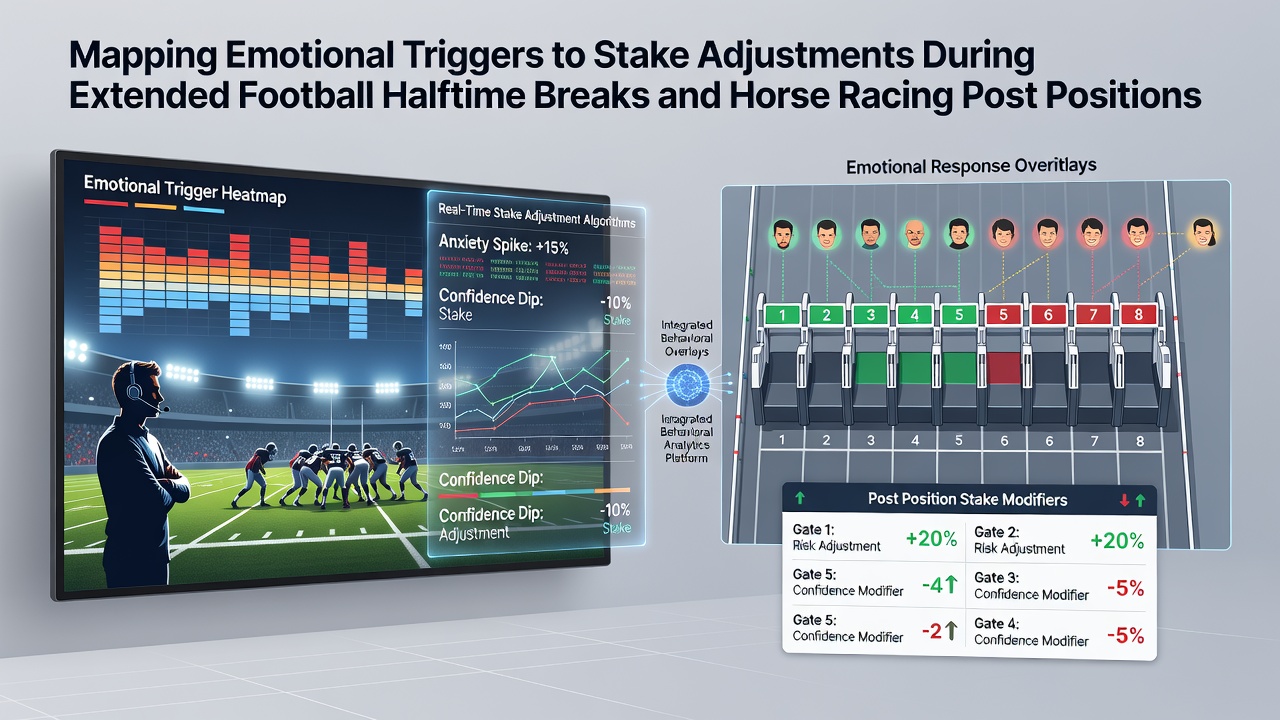
Extended halftime breaks in football create distinct windows where bettors encounter emotional responses tied to match developments, and researchers have documented how those responses connect to stake decisions in subsequent periods. Studies in behavioral finance show that periods of reflection during pauses allow physiological changes such as elevated heart rate or tension to influence perceptions of value on remaining markets, and data from multiple seasons indicate measurable shifts in wager sizes when bettors review prior outcomes before play resumes.
Patterns Observed in Football Halftime Scenarios
Analyses of betting records reveal that extended intervals exceeding fifteen minutes often coincide with adjustments in stake levels, particularly when teams display contrasting styles that prompt reevaluation of expected goal outputs. Observers note that anxiety following defensive lapses tends to reduce stake amounts on high-odds lines, while confidence after offensive sequences correlates with maintained or increased positions on draw outcomes. Figures from industry datasets compiled through 2025 highlight consistent patterns across European leagues where halftime stake changes average between eight and twelve percent of pre-match allocations.
Those patterns emerge because bettors receive updated statistical inputs during breaks, and the combination of fresh data with lingering emotional states produces recalibrations that differ from initial selections. Research conducted by academic groups at institutions including the University of Sydney demonstrates that cognitive biases such as recency weighting become amplified when time permits rumination, leading to stake modifications that align more closely with momentary sentiment than with long-term probability models.
Connecting Emotional Responses to Post Position Dynamics in Horse Racing

Post positions in horse racing generate parallel emotional triggers because starting gate assignments carry historical performance associations that bettors weigh against current form. Data compiled by the Australian Gambling Research Centre indicates that inside draws frequently elicit higher stake commitments when accompanied by positive prior results, whereas wide barriers correlate with reduced positions even when speed figures remain competitive. These adjustments occur rapidly during pre-race windows, and the brevity of decision time compresses emotional processing compared with football halftimes yet produces similar directional changes in capital allocation.
Behavioral tracking studies further show that visual cues from paddock parades interact with post position knowledge to shape final stake levels, and records from North American tracks reveal that bettors who adjust positions mid-parade exhibit greater variance in returns than those who maintain preset amounts. The interaction between spatial positioning and emotional valuation therefore forms a mapping framework that operators and analysts use to interpret market movements before races commence.
Integrated Mapping Frameworks Across Both Sports
Cross-sport comparisons conducted by research teams at McGill University illustrate that emotional trigger mapping operates through shared mechanisms despite differing time scales. In football the extended pause allows layered information processing, whereas horse racing decisions unfold within tighter intervals that emphasize immediate physiological responses. Both contexts demonstrate that stake adjustments follow identifiable sequences beginning with trigger identification, followed by probability reassessment and culminating in revised position sizing. Reports issued in July 2026 by European sports analytics firms confirm that platforms incorporating trigger-based prompts record lower instances of impulsive over-staking when users receive structured reflection intervals.
Implementation of such frameworks relies on documented correlations rather than predictive guarantees, and regulators in multiple jurisdictions require clear disclosure of how emotional cue recognition intersects with responsible wagering tools. Industry organizations including the Responsible Gambling Council in Canada publish guidelines that reference these mappings as part of broader harm reduction strategies, and the materials emphasize objective measurement of stake variance over subjective interpretation.
Data Sources and Measurement Approaches
Quantitative models draw upon anonymized transaction logs that segment stake changes by elapsed time and market type, and external validation comes from sources such as the Nevada Gaming Control Board quarterly reports which track aggregate betting behavior across major sportsbooks. These datasets allow construction of trigger-to-adjustment matrices that map specific emotional indicators to observed capital shifts without attributing causation beyond statistical association.
Conclusion
Mapping emotional triggers to stake adjustments provides a structured lens for examining decision points in both extended football halftimes and horse racing post position evaluations. Evidence from academic institutions and regulatory bodies across regions demonstrates consistent patterns in how bettors modify positions following identifiable cues, and ongoing data collection through 2026 continues to refine these matrices for operational and research purposes. The frameworks remain descriptive tools that highlight observable relationships rather than prescriptive systems for future outcomes.